Read how Aleksandra Sawik is Building Her Portfolio, Growing in Confidence and Securing Exciting Commissions Along the Way!

“I’m very happy that I decided to start the mentorship with you, Helen. It has been about three months now, and I feel that our meetings, emails and the tasks you give me have helped to reorganise the way I think. This change is happening not only in my head, but also in my working environment — even in my flat. I’m using the space I have for work in a different way.
Today, I realised that many of the problems I used to have when composing scenes with multiple figures or landscapes are starting to fall into place thanks to our sessions. I feel as though I’ve crossed a difficult but crucial point in my work.
The colour palette exercise was a game changer. Even though I had seen others do it, I didn’t know how to approach it myself. I’ve made so much progress in such a short amount of time.
I feel that the mentorship has given me much more confidence and has really changed my mindset. I feel much more secure as an illustrator now. And this is still early in the mentorship process, which makes me very happy.
I wanted to thank you because, thanks to the mentorship, many doors are opening for me — including in my own mind. Recently, I went to a book fair and found the courage to talk to people and show my work, and it went really well.
At the moment, I’m working on an illustration commission for Newsweek Psychologia, and I’m also going to another book fair here in Poland. I’ve been invited to take part in an exhibition about bees!
I’m very grateful because I feel the mentorship has given me much more confidence and really changed my mindset. I feel much more secure as an illustrator now — and the mentorship process isn’t over yet, which makes me very happy.”
Tell us about your current artistic process — what do you use and what is important to you when creating?
I usually start with pencil sketches on paper. I love using coloured paper and cut-outs. I draw and paint on paper, create collages from those elements, and then finish the illustration on the iPad or sometimes on the computer. When I work with a stricter brief, my cut-out process becomes more planned and organised.
What is very important to me is staying open to accidents and unexpected effects, noticing them and using them in an artistic way to explore new possibilities.
Variety in my approach to illustration is also essential to me. I constantly experiment with different techniques and processes because it keeps my illustrations vivid, helps me stay curious and prevents me from getting stuck in repetitive or limiting patterns.
What have you focused on during the mentorship?
I am currently developing a portfolio that I will use to apply to illustration agencies, with a particular focus on editorial illustration for the international market. Achieving this is one of my main goals for this year.
At the same time, I am developing a more spontaneous and expressive way of creating illustrations aimed more towards children’s books.
Why did you decide to do the mentorship?
I felt that I already had my own style, but my portfolio still wasn’t as consistent as I wanted it to be. That’s why I decided to seek professional guidance to help me achieve that consistency.
How did you feel about your illustrations before you started the mentorship programme?
I felt less confident about my work than I do now, even though I had already worked with several clients. I also didn’t fully understand the professional decision-making process within the wider illustration industry, and working with Helen has made this much clearer to me.
Before the mentorship, I don’t think I had the same ease when approaching certain topics and challenges within my illustrations. Even after just a few meetings with Helen, I noticed a significant change in the way I think about and create my work.
Tell us about the commissions you’ve received whilst being on the mentorship.
Recently, I created illustrations for two Polish magazines — Znak and Newsweek Psychologia. Both commissions made me very happy because this is exactly the type of editorial illustration I am currently developing during my mentorship programme. It is a wonderful feeling to see my illustrations published in a printed magazine.
At the beginning of the year, I was also selected to take part in a group exhibition for illustrators organised in connection with the Poznań Book Fair.
During the same period, I created an illustration for an exhibition dedicated to bee protection, which will be presented in several locations across Poland and in Switzerland. The illustration will also be sold in the form of a postcard.
I have also just received another commission from a local business, which I’m thrilled about.
How does the support of an industry professional help you build your portfolio?
I am still in the process of building my portfolio, and it is a great pleasure to watch it grow. Of course, I still have many doubts about what to do and whether I am heading in the right direction, but with Helen it is much easier to talk things through and not feel alone in the process.
You have a focused and important year ahead — what are you working towards?
Last December, I decided to begin mentorship with Helen to create a portfolio that I could use to apply to an illustration agency, with an emphasis on editorial illustration.
The first half of this year has been filled with many important and inspiring experiences. Together with a colleague, we designed the logo and visual identity for an important newly established illustration institution — the Society of Polish Illustrators.
I also took part in an illustrators’ exhibition accompanying the Poznań Book Fair. In addition, I participated in an exhibition organised by the association itself, and my work will also be presented at an exhibition dedicated to bee protection, taking place in several cities across Poland as well as in Switzerland.
Recently, I was commissioned to create illustrations for two Polish magazines — Znak and Newsweek Psychologia — and I have also received a commission from a local business.
At the same time, I created a mock-up of my own children’s book, and I am currently working on another children’s book, this time aimed at boys. I would like to take both of these books to the Bologna Children’s Book Fair next year, especially as Poland will be the Guest of Honour. I also believe that, thanks to the support of the Society of Polish Illustrators, this trip will be an incredibly inspiring and valuable professional experience.
I try to work in many different directions and continuously develop myself across several creative fields — or at least do my best to do so!

Can you tell us about your book?
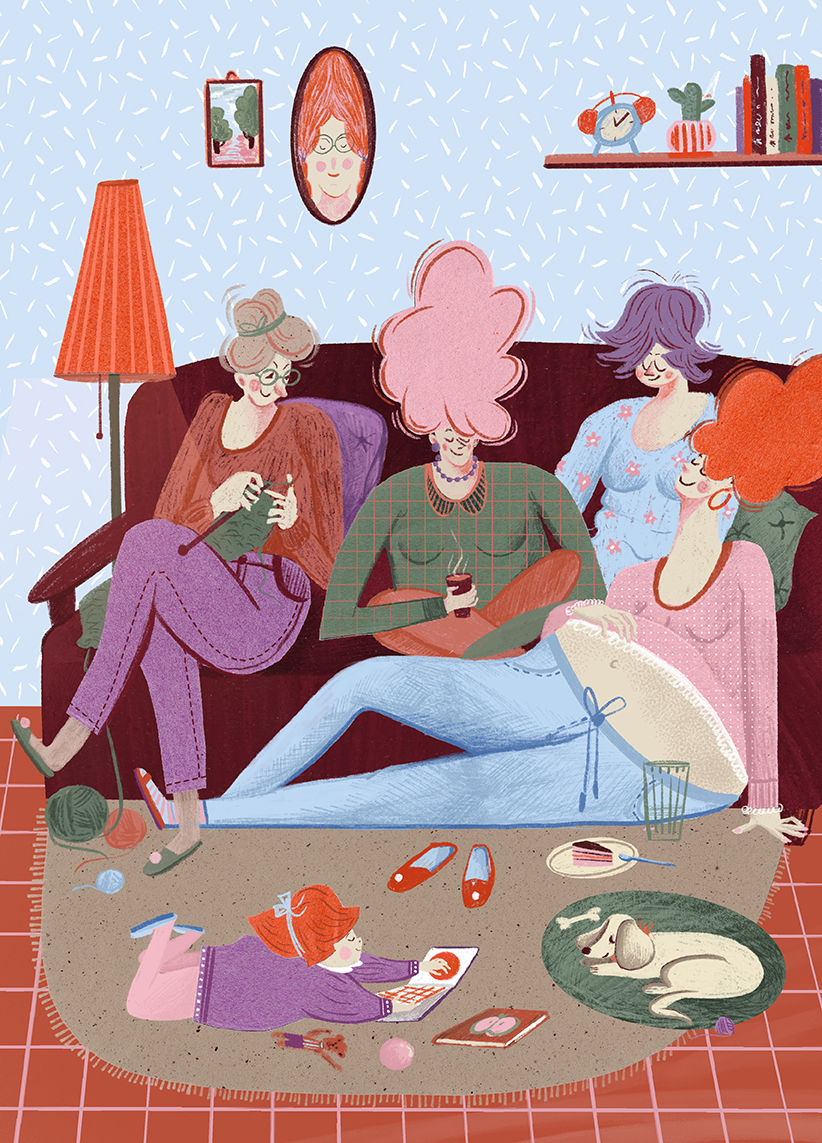
My original book, What a Princess Is Allowed to Do, featuring both my own illustrations and text, is aimed at children, especially girls. Its purpose is to challenge stereotypical ways of thinking about the roles in which girls are raised from an early age.
The title character, the “princess”, is an ordinary little girl, and the term is used somewhat ironically as a reference to the social expectations placed on women. The book takes the form of a playful rhyming poem, showing that girls are also allowed to be mischievous, authentic individuals who experience a wide range of emotions and moods.
The illustrations were created using handmade paper cut-outs combined with drawing and digitally refined on a computer and iPad. The result is an artistically crafted book for children that also remains engaging and meaningful for adult readers.

What clients would you like to work with in the future, and what can you offer them as an illustrator?
I’m particularly interested in three types of commissions.
The first is editorial illustration, which gives me great pleasure because I enjoy illustrating articles. The process of finding a concise and symbolic way to capture the meaning of an entire text is one of my strongest skills.
The second is children’s books. In this field, my way of thinking and illustrating becomes a little different: more spontaneous, less polished and full of energy, which I really enjoy. In these illustrations, I mainly use analogue techniques such as cut-outs, drawing, painting and collage.
Working on a book also requires thinking about the project as a whole concept rather than as a series of individual illustrations. I enjoy creating interconnected, complementary images that work together.
The third area is packaging and games. I have already worked on a board game project, Poison, created by Reiner Knizia, one of the world’s most renowned board game authors. It involves a similar way of thinking to creating a book. I need to consider the entire visual system — cards, instructions, notes, packaging and all the accompanying elements. I enjoy working on larger projects and making every part feel visually consistent.
I can offer an individual approach depending on the medium I am illustrating for. I especially enjoy combining analogue techniques with digital tools and experimenting with the dialogue between the two.

Why do you like working on client commissions?
I like the challenge of having a topic to illustrate, as it demands that I make an intellectual effort to find the best way to communicate it. I enjoy searching for meaning and using metaphors in my illustrations.
I also enjoy thinking about the formal solutions — which colour palette to use, which technique to work in, or how to show something in an interesting way through a less typical composition or angle. I find this process really enjoyable and rewarding.
It makes me feel that I am continually developing my skills, not only practically and technically, but also in the way I think as an illustrator.
What are your future plans for your illustration career?
I’d love to join an illustration agency and work with experienced professionals, gaining their support and insight into the illustration industry for a few years. After that, I think I would feel ready to become a fully independent freelance illustrator.


Comments